I’ve found that this family history lark throws up all sorts of stories: tragic, funny, heartwarming…the whole range. My approach to digging up the information has some sort of methodology, but often just consists of me typing words into Google, hitting Go and seeing what comes up.
In one instance I typed in the name of Rosina Wimmer and up popped the website of the Gondwana Travel Centre in Windhoek, Namibia. The website included a variety of stories about Namibia, including the story of Agnes Hill, the daughter of Charles Hill and Susannah Rosina Wimmer. Susannah was a daughter of Michael Wimmer and Margarethe Beukes and Charles Hill was a grandson of one of the so-called 1820 Settlers to the Cape Colony.
At the start of the 19th century, post the Napoleonic wars, Britain had a problem with unemployment. In southern Africa there were regional wars in the eastern part of the Cape Colony with the Xhosa people. The solution was to encourage British people to emigrate to the Colony, to boost the population of Brits in the Colony and to settle along the border with the Xhosa people’s land as a form of defence (a sort of 19th century version of the “ten-pound pom” initiative). Over 4000 such families took up the offer and migrated to the Cape Colony in 1820.
One of the families on the ship was the Hill family. One of the grandsons – Charles Henry Hill – born in Grahamstown in the Cape Colony became a trader and trekked up to the north west region of the Colony where he met Susannah Rosina Wimmer at Steinkopf where he had stopped off during his treks through the region. They married on 19 April 1858 but were established in their respective professions as a trader and missionary worker. They acquired a house from the Steinkopf mission and initially settled there. This would remain a home for the Hills until Susanna Rosina’s death in 1920, when ownership of the house reverted to the mission.
Eventually the Hill family acquired farmland around Hoorlog and Groendoorn in what is now Namibia and settled there, while Charles went into business with a Robert Duncan. Susanna Rosina and Charles Henry raised eight children: Donald Duncan, James Henry, Roland Martin, Charles John, Agnes, Elizabeth, Wilhelmina Charlotte and Margaret Susan. The children were educated privately at home and the daughters also sent to boarding school in England.
Three of the daughters married but one of the daughters – Agnes – never married. Agnes met and fell in love with a German man called Max Kuno von Quitzow. He arrived in Africa as a soldier but later left the army to settle into civilian life. In 1984, days before their planned marriage, Max got lost in the desert trying to make for a waterhole. He died just 2km from the waterhole. Agnes never married and spent the rest of her life at Hoolog and died some 40 years later.
We have a photo of Agnes. How elegant she looks.
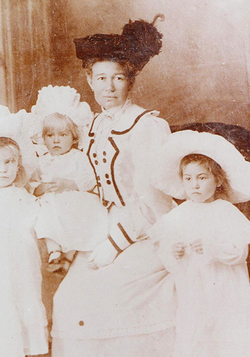
…and her sister Margaret Susan..
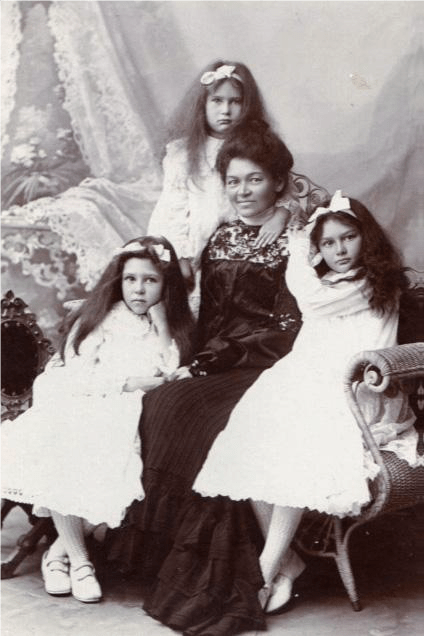
Charles Henry died in 1900 from a heart attack at the age of 66. His estate was divided up between his children and Susannah Rosina became the head of the family.

After Charles Henry’s death, Susanna Rosina established a mission station called Klein Karas, as a branch of the Keetmanshoop mission, with a Rhenish missionary Heinrich Friedrich Rust. Friedrich Rust was the successor to Tobias Fenchel at the Keetmanshoop mission. Michael Wimmer had close links with Rhenish missionaries and Susanna Rosina’s sister, Elizabeth, had married the Rhenish missionary Johann Friedrich Hein and settled in Kuboes. Many Steinkopf residents had migrated to Keetmanshoop in the late nineteenth century, among them members of the Wimmer and Hein families. Two of Susanna Rosina’s nephews, Michael Wimmer and Frederick Hein, became church elders and were trained in the evangelist school in Keetmanshoop. In 1893 Jan Wimmer, another relative, also became an elder.
In telling this story, I am indebted to Mr Hergen Junge, a descendant of Charles and Susannah Rosina, who has done an immense amount of work on the family history and supplied me with these lovely photos.
 Things you didn't know about my family