Before you read this, can I suggest that, if you haven’t already done so, you read the post about James Mazey. This will provide you with some context for this post.
Having read the account of James Mazey’s life, I hope you will understand why I’ve marked Sarah as a superwoman. In an era where there was no social support (other than your family) she managed to raise eight children despite a husband that was not only absent for long periods of time, but when he was around was a violent man and probably an alcoholic.
I do wonder why Sarah and James hooked up in the first place. We do know that Sarah was pregnant before they got married and, despite intending to get married when Sarah was pregnant for the first time, they never did. Instead, they had another five children before they married in 1865. They had a further two children after their marriage. However, James was often absent and so, in many respects, Sarah was a single parent.
It was not long after their marriage that Sarah (and James) moved to Bingley.
In the 1860’s the silk ribbon weaving industry suffered a terrible decline, so it looks like they upped sticks and relocated to another part of the country to seek work. A quintessential Norman Tebbit “on yer bike” sort of attitude. I can’t imagine that this would have been easy.
I have no idea why they chose to move to Bingley.
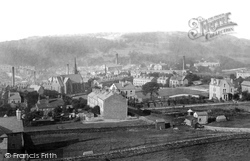
Obviously, the northern areas of England would have more opportunities for jobs, but why they chose Bingley is a mystery. Pictures of the time show Bingley as quite a pretty town (apparently John Wesley had referred to it – nearly 100 years prior – as a “little paradise”).
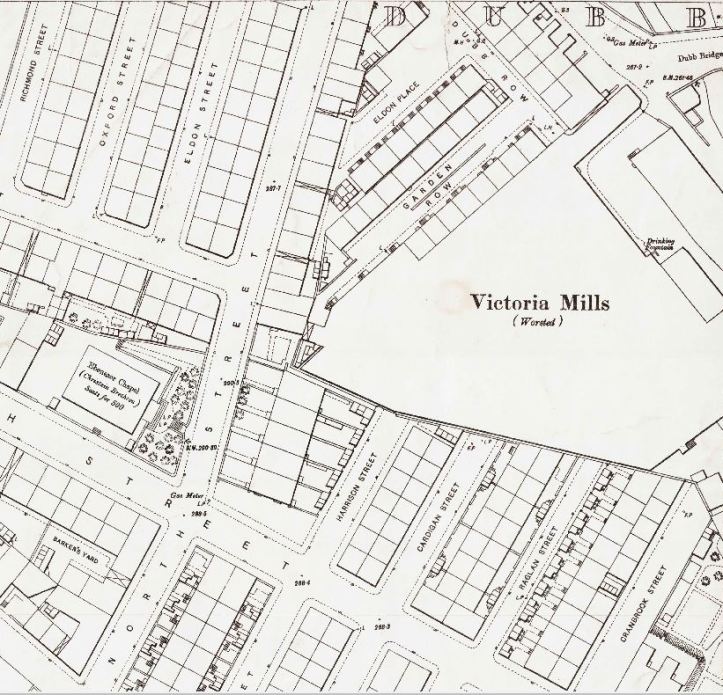
When Sarah first moved to Bingley, she lived on Garden Row (see above, left of Victoria Mills), later moving round the corner to Dubb Row and then again to Eldon Place, behind Garden Row. Later on she lived with her daughter on Church Street which is the road running diagonally south of Victoria Mills.
In May of 1874, James returned to Bingley and violently assaulted Sarah by hitting her about the head with a poker. She was left seriously injured and James was sentenced to 9 months hard labour. The post about James provides more details on this. Her youngest son, John, was just six months old. It is difficult to imagine how it must have been for her, but it looks like she had friends and family around to support her.
In any event, and despite this, she appears to have settled there, raising her family, who, in turn, settled their own families in Bingley: some of which are still in Bingley today.

My research did raise a few queries about Sarah’s family.
The first is in relation to her daughter Ann Maria born in 1851 of thereabouts. The records are clear: Sarah and James did have a daughter called Ann Maria. Ann Maria later married a Samuel Anderton from Bingley and they had a son named Harry. In the late 1880’s they migrated to the USA, where she died in 1938. However, in the 1871 census, she is missing from the record in which the rest of her family are listed. However, there is a Harriet Mazey recorded. Harriet Mazey doesn’t appear in any oether record so I am assuming for that period around 1871 i.e. after they moved to Bingley, Ann Maria became known as Harriet (at least for a while). I wonder why?
Secondly, are Isaac and John (Sarah’s two youngest children) actually the sons of James?
The question arose because we know that James was often absent.
Isaac was born in 1869 in Bingley. There are no records that put James anywhere other than with Sarah in the period between 1868 and 1869 so we shall assume that James is Isaac’s father.
John was born in in November 1873. In May 1874 – when James attacked Sarah – newspaper reports stated that he had been absent for about 12 months i.e. between May 1873 and May 1874. In September 1873 James was convicted of being drunk and disorderly in Coventry and sentenced to 2 months in gaol, so that also puts him away from Bingley. However, crucially, James could still be the father of John as he could have been in Bingley between February and May of 1873.
So, in the absence of anything to contrary, we have to assume that James is John’s father too.
Isaac and John went on to become quite successful as managers of a mill board/leather board manufacturing company. They both died within months of each other in 1939, leaving estates valued in the region of 40,000 pounds in today’s money.
The reports of James’ attack on Sarah in 1874 make harrowing reading and I wonder how she recovered from that. Did James ever return to Bingley after that? We know that he finished his last years living in Macclesfield in Cheshire.
Sarah died in April 1907 in Bingley. In the last years of her life she lived with her daughter, Sarah, her husband James Rhodes and their children.
 Things you didn't know about my family