Nothing is more synonymous with the industrial revolution and the beginning of the modern industrial age than the mills and mines of central and northern England. The family histories of both myself and Mike are bound with this momentous shift that happened from the mid 18th century onward. While some of my family toiled in the cotton mills of the West Riding of Yorkshire and the coal mines of the North East and Yorkshire, one branch of Mike’s family made their mark in the coal mines of Lancashire: Burnley to be precise.
The Waddington family of Burnley is huge…by which I mean the family is big and disparate. There is even a book called “Who’s Who in the Waddington Family”, published in the early 20th century. This means that, while it might appear easy to find Waddington ancestors, you are never quite sure whether you have the right one, as it is not unknown to have two (or more) Waddingtons born in the same place with the same name at around the same time. Each family seems to have at least 5 or 6 children and often more so once you start following one lead, you are faced with large number of additional family members.
Mike’s great grandmother was called Mary Waddington. She was one of eight children, born to Richard and Ann Waddington. Richard himself was one of eight children: you get the picture.

The Waddington family were a significant family in Burnley. They were architects, solicitors, bakers, textile workers and printers. Richard Waddington and his brothers and cousins, as well as his father before him were colliery managers.
Some of you may remember the MP David Waddington (later Baron Waddington), at one time Home Secretary under Margaret Thatcher. He was descended from the lawyer branch of the Burnley Waddingtons.
The largest colliery company in the Burnley area in the 19th century was the Executors of John Hargreaves Ltd. company, originally founded by a Colonal John Hargreaves in the early 1800s. Richard Waddington’s father, John, joined the firm at around the age of 12 at the firm’s Simonstone colliery in Padiham near Burnley and by 1872 he was the general manager for the company. He retired in 1881 due to ill health but continued in a consulting role until his death in 1883. From newspaper reports at the time he was a well respected manager and well liked.
John had two living sons – Henry and Richard. Henry was elder of the two by some 18 years, and both were working as colliery managers at the time of Johns death: Henry at the Bank Hall Colliery and Richard at the Habergham Colliery which had opened in 1873. Both collieries were owned by Executors of John Hargreaves Ltd.
Sadly, however, Richard was also dead within 4 months of his father, from TB, and aged only 32. His baby daughter, Margaret, had died just a month before.
Henry had an inventive bent too. In 1873 he was granted a patent, along with a chap called Thomson Bailey for an improved miner’s safety lamp. It lapsed in 1876 due to non-payment of a £50 stamp duty.
Henry died thirteen years later in 1886.
It looks like Henry’s son, Nicholas, took over the reigns at Habergham colliery after Richard’s death, although he was only 20 years of age, and shortly after his marriage and the completion of colliery manager studies at Owens College in Manchester. Owens College is now known as Manchester University.
Nicholas was manager for 10 years before he died at the tragically young age of 30. His younger brother, James had died in 1881 at the age of just 25 reportedly from a stroke after returning home from colliery band practice. Two brothers and a cousin all dead in their 20s or early 30s……
The Waddington’s were clearly a musical family. Newspaper reports of the time have Henry as a player of the ophicleide (a sort of tuba) and Richard a player of the violin.
Richard’s death in July 1883 left his wife, Ann looking after their seven children, the eldest being Henry and a toddler, Tom. Mary was their fourth child and fourth daughter. At some point she met James Slater – their marriage certificates indicates that they both worked as weavers and lived near each other: perhaps they met at the mill where they worked. They married in 1893 – Mary was 18 and James 21 – and Mary was three months pregnant. Their daughter Margaret Evelyn was born six months after they married. Their sons John (known as Jack) and James (known as Edgar) were born in 1895 and 1897 respectively. Sadly, just three months after Edgar’s birth and around the time of her fourth birthday, Margaret died. James’ own father had died just a month after Edgar’s birth – 1897 was year of joy and also sadness for the family.
From all accounts the Slater boys were friendly with their Waddington cousins and, indeed I am in contact with one of the descendants of Mary’s brother Tom, who has very kindly provided me with information and photographs – including the photograph of Mary.
The coal mines of Burnley are no longer – Habergham closed in 1941 – but many of the buildings remain and have been put to other uses.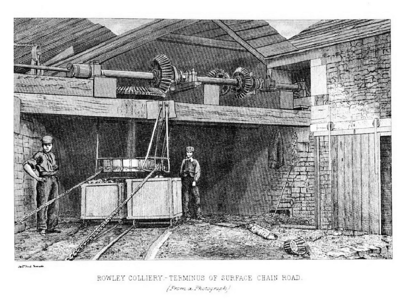
 Things you didn't know about my family