I’ve called this the mysterious Seiller family because this family has been, for many years, a mystery to me. If you haven’t already, it might help if you read my earlier blog about the two Tinley sisters: Henrietta and Letitia. Letitia was Mike’s gt.gt grandmother and she married an Octave Seiller – who is Mike’s gt.gt. grandfather.
You can read the sisters’ story here – https://slaterfamily.blog/2017/07/08/a-tale-of-two-sisters/
Letitia and Henrietta were the youngest children (and the only daughters) of Mary Ann Tinley (nee Newport) and Gervaise Tinley. Gervaise was a military man serving as an officer with the 9th Regiment of Foot. He saw action under the Duke of Wellington in the Peninsular Wars of the early 19th century. He died when Letitia was only three (and Henrietta ten). Gervaise and Mary Ann had three sons who survived into adulthood and all followed in their father’s footsteps into the army.
Henrietta married at the young age of 16, but was a widow with a young child within a short period. Letitia married Octave Henri Seiller at the age of 21. His family has been difficult to track down.
As I mention in my previous post, Octave appears to have been an errant husband: if Letitia’s accounts are anything to go by. He tried to make a living buying and selling horses, but was usually in debt and being chased by creditors.
According to a court petition filed in 1874 by Letitia, Octave simply left their marital home in August of 1868 after more than ten years of marriage: never to return and taking their eldest child (George-Octave) with him. Letitia was left with their two younger children (Helene Marie and Frederick). Letitia saw Octave once more the next year in 1869 in Brussels, but never saw her eldest child again.
Shortly after that, Letitia returned to England and settled firstly in the Isle of Wight, with Frederick and Helene and working as a needlewoman, and then latterly back in Hertfordshire: the county home of her mother’s family. Sadly her financial position does not appear to have improved and by 1875 she turns up in London in the workhouse and by 1879 she is dead.
But what of Octave? Who was he and was he really as bad as Letitia made out? What happened to George-Octave? I had tried really hard to find out the answers, and the other week I came across a French website which provided me with some answers (although not all).
The website has a whole heap of birth, marriage, death and census records and has enabled me to find out a little bit more about the man who simply upped sticks and deserted his family.
Using this website, I found a copy of Letitia and Octave’s marriage record, as well as Octave’s birth record and those of George-Octave and Helene too.
It turns out that Octave Henri Seiller was born on the 20th August 1827 in Amboise, in the Loire Valley in France. Amboise is known for it’s impressive castle which has housed French and British royalty over the centuries. I visited the Loire valley as a child I remember it being very beautiful.
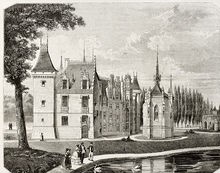
Octave Henri was the son of a Jean Baptiste Louis Seiller and his wife Jeanne Francois Felicite (nee Dubois).
In Octave’s birth record, Jean Baptiste’s profession is given as a “notaire royale”: a lawyer involved with overseeing and recording transactions. Notaire royales were supposed to have been dissolved during the French Revolution some thirty years before Octave’s birth as their jurisdiction was given by the monarch, but perhaps this position was reinstated when the monarchy was restored in in 1815 after the downfall of Napoleon.
Jean Baptiste’s father (also called Jean Baptiste) was also a notaire royale. Jean Baptiste’s brother, Prosper, was a teacher. It would appear, therefore, that Octave came from an educated and perhaps you could say middle-class family. Certainly, on the basis of his family background, not an obvious candidate for a dysfunctional lifestyle.
The next event that I can find a record for, is Octave and Letitia’s marriage. This took place on the 30th December 1857 (not on the 31st December 1858 as stated in Letitia’s affidavit of 1874).
They married in a place called Dinan in Brittany. I wonder why they married there? It is some distance from Amboise. The marriage indicates that Octave is from Tours (near to his birthplace of Amboise) and is a landowner. The record shows that Letitia was born in Aught, Ireland in 1835 and that her mother is residing in Boulogne at the time of the marriage. Boulogne is some 300 miles from Dinan, so it’s not as if this was where Letitia was living.
So this is still a mystery: how did they meet and what were they doing in that neck of the woods?
A newspaper cutting from September of 1858: just nine months later shows Octave living in Saint Pience about 50 miles from Dinan. The newspaper cutting relates to the sale of Octave’s assets: linen, drapery, travel trunks and other various items. A first indication maybe that things are not going well.
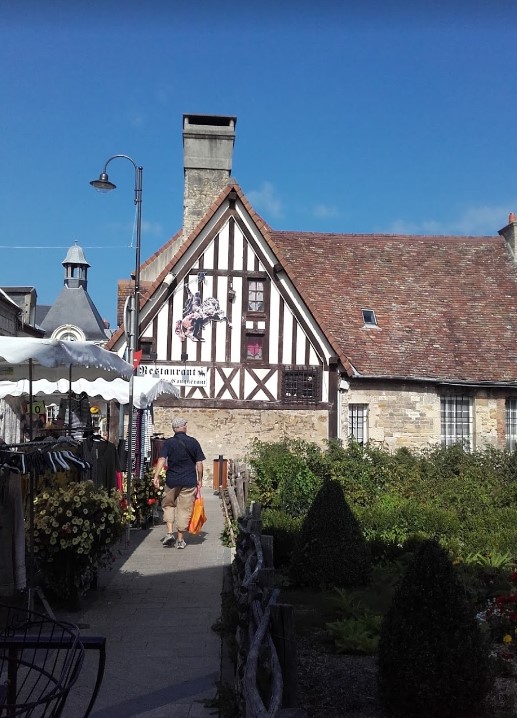
During that same month – on the 9th September 1858 – Letitia gives birth to George-Octave in a town called Dives-sur-Mer. This is not too far from Saint Pience (about 80 miles or so), but still a distance. The birth record says that both Letitia and Octave are from Tours (there is no mention of St. Pience) and that they are staying at the hotel “Le Guillame le Conquerer” when Letitia gives birth. Are they just passing through on the way to somewhere else? Perhaps to Letitia’s mother Boulogne, which is further up the coast.
The hotel still exists and appears to be quite an attraction.
The next record is Helene’s birth on the 30th August 1860, almost exactly two years after George-Octave’s birth. Helene is born in the small hamlet of Gressets some four miles from the Palace of Versailles. So, within those two years, they have moved and seem to be settled in the Paris area, but certainly her first few years of married life appear to have been unsettled.
In 1863, there is a newspaper report of Octave being charged with poaching in Honfleur, but gives his address as Neuilly-sur-Seine – which is what is now the heart of Paris – and having the job of horse trader.
This is in accord with Letitia’s affidavit which tells of them living in Paris and Versaille and Octave being a “seller of horses”. She also mentions a spell in Brussels, but I’m not sure when that was.
In July of 1868, we know that she and Octave are living in Neuilly, but that he then walks out on her and takes George-Octave with him. After that we know nothing more of his fate or that of his son.
It is interesting that the Letitia maintains the pretence (in most public documents at least) of Octave’s professional standing: referring to herself in her workhouse admission records nearly a decade later as the widow of a lawyer.
When Frederick marries some thirty years later, he gives his father’s name as Frederick Seiller and his profession as a solicitor.
There’s still a lot we don’t know about Octave Seiller: obviously a complex man. Let’s see what else I can dig up.
 Things you didn't know about my family