For those of us with a British education, I am sure most of us will have studied the Irish Famine at school: that dreadful period between 1845 and 1852 where mass starvation and disease as a result the spread of potato blight throughout Europe, led to the death of of around 1 million people and the exodus of a further 2 million people from the Ireland of Ireland.
Both Mike and I have Irish ancestry and I have always assumed that our ancestors must have been impacted in some way but never really knew to what extent. My Irish ancestors didn’t leave Ireland until the late 1870s to work in the coal mines of the North of England, but my research into Mike’s Irish ancestry has shown that his ancestors left Ireland several decades earlier. DNA results show that Mike and I share similar Irish DNA in so far as our ancestors both come from the Connacht province of Ireland. My family (the Swords family) are from County Sligo but I was never sure about Mike’s family, until I started doing some more digging recently.
Mike’s granny – Norah – was the daughter of James Regan and Hannah Ashworth from Manchester. James and Hannah lived in the south part of Manchester: in Stretford not far from where Manchester United’s Old Trafford ground is now and then later in Whalley Range a bit further out.
James was born in Manchester to Patrick and Mary Regan. Mary was born in Manchester and died at the age of 40 having had three children: James and his siblings John and Margaret. Patrick remarried soon after to a lady called Martha.
Patrick is the Irish link in Mike’s tree.
Patrick was born in Ireland in about 1835 and arrived in England sometime probably in the 1840s with his mother Elizabeth Rogan (born Ward). Looking at the records of that time, it was clear that Patrick’s surname was usually written as Rogan as opposed to Regan but by the 1870s he was using the surname Regan predominantly. I’m not sure why the name was changed, perhaps just circumstance rather than for any specific reason. Looking at Patrick’s marriage certificate to Mary Tye on the 27th July 1856 he simply signs the certificate with his mark: indicating that he couldn’t read or write so wouldn’t have known how his name was written and pronunciation may have meant that it was misspelled. In any event Rogan/ Regan is an anglicisation of an Irish surname. According to the Family Search website Rogan is shortened anglicized form of Gaelic Ó Ruadhagáin ‘son of Ruadhagán’, a personal name from a double diminutive of ruadh ‘red’. This was a chieftain family in Armagh, and the surname was used across the west and north of Ireland. Interestingly, according to the same website, Regan is shortened form of O’Regan , an Anglicized form of Gaelic Ó Ríagáin ‘descendant of Riagán’, a personal name which is perhaps akin to ríodhach meaning ‘impulsive or furious’, so a slightly different etymology.
Patrick and Mary’s marriage certificate gives Patrick’s father as a John Rogan, but the earliest record I can find for him is the 1851 UK census in which he is living with his mother, Elizabeth, and stepfather Christopher Burd, brother John and step sister Mary. In that census, Elizabeth and Christopher are both down as being born in Ireland, but they married in Manchester in 1845, but its not clear whether they met in Manchester or Ireland. Did Elizabeth travel to England from Ireland on her own with her two sons sometime in the early 1840s? At the time of her marriage she was living on Moss Lane in what is now Moss Side. She stated to be a widow. Her husband to be was living elsewhere in Manchester, so I suspect they met in Manchester and so she probably did make the move on her own.
I did manage to find a marriage record for Elizabeth in Ireland on the 30th December 1834, to a John Rogan of Gortletteragh, so this would appear to be John and Patrick’s parents. I found a baptism record for their son John on the 18th February 1838 in Gortleterragh, but I can’t find any record for Patrick but I assume that he, too, was born in around 1835 in Gortleterragh.
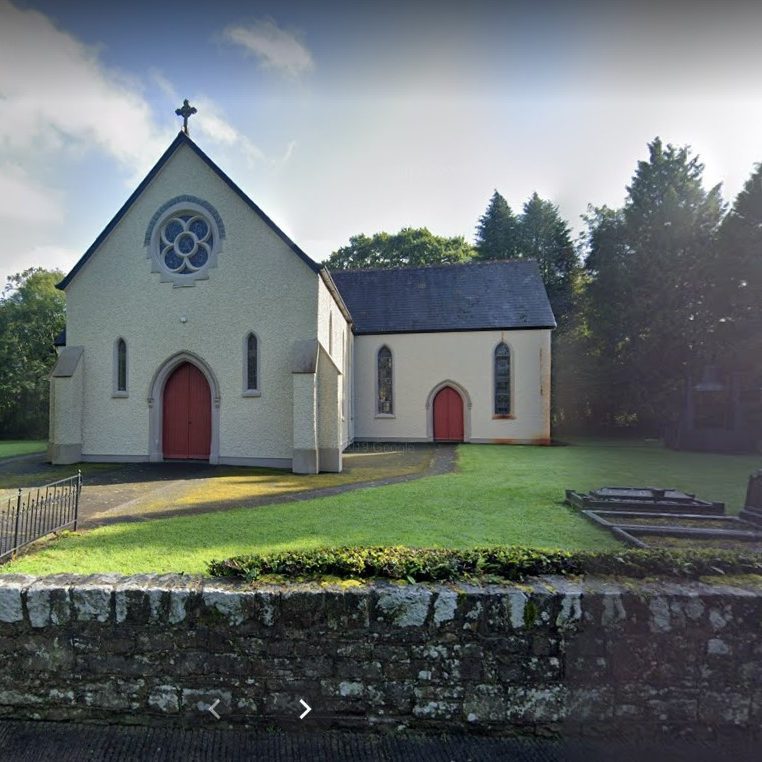
Gortleterragh is a townland in County Leitrim. Its gaelic name is Gort Leitreach which means field of the wet hillside. It borders Lough Rynn and is close to the border with County Longford. Photos show a lovely looking townland based around a church.
An important resource for genealogists exploring Irish ancestry is the Griffiths Valuation which was a boundary and land valuation survey carried out in the mid 19th century. It details the owners and tenants of all the land in Ireland. The survey of County Leitrim was carried out in 1857. This is some years after Elizabeth would have left but a search through the records showed that even in 1857 members of the Rogan family were still living there: mainly in the townland of Gortleterragh and the nearby townland of Drummeen.
What caused Elizabeth Rogan to leave Ireland? If she left in the early 1840s, the Irish famine had yet to reach its worst point, but there is no doubt that poverty was endemic in Ireland at that point. Catholic people were disenfranchised and at the mercy of absentee landlords. Potatoes were one of the few crops that could be grown in the small tenanted blocks of land. The death of her husband may well have meant that she was evicted from her home, meaning a move to England was one of the few options available to her.
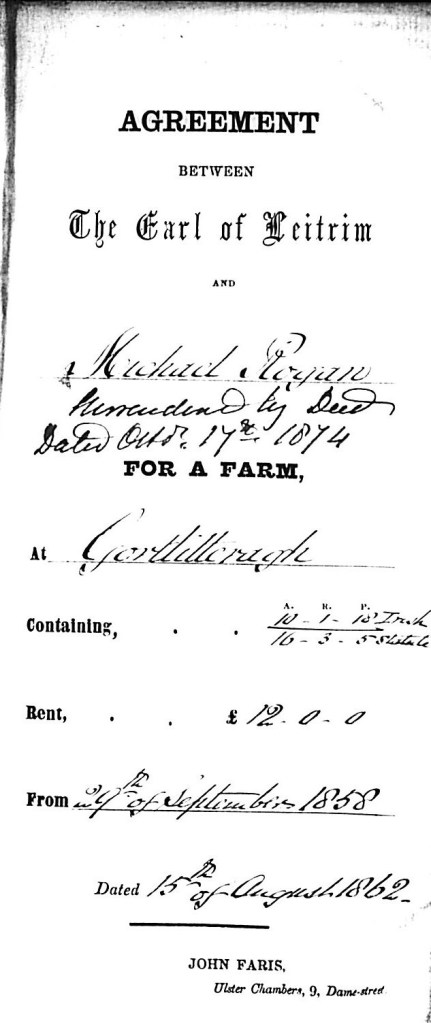
But what about those left behind. Several of the Rogan family were tenants of the Earl of Leitrim who is known as a tyrannical landlord, prone to evicting tenants. Whilst tenants had been given some leniency during the famine by the end of the 1840s, indiscriminate mass evictions were taking place. I came across a publication about the role of the Earl of Leitrim in the eviction of a Michael Rogan of Gortleterragh in 1874. Michael’s tenancy was so restrictive that it made it very difficult to make a living and he was eventually evicted.
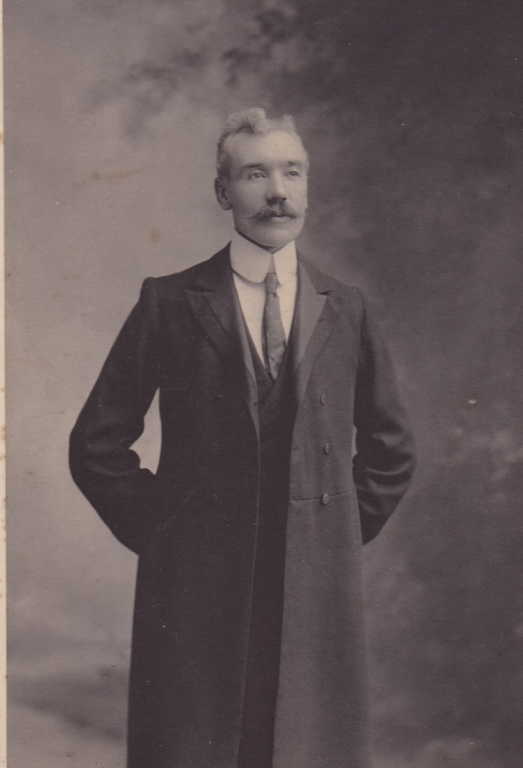
Her move to Manchester seems to have been the right one. Her son, Patrick, despite his illiteracy became an engine driver, and his son James became vaccination officer in Manchester and his daughters became a doctor and a school teacher respectively.
 Things you didn't know about my family