NOTE: This post has been updated with additional information that I have received since I first wrote it.
I’m going to start this blog with Michael Wimmer: he’s Mike’s gt.x3 grandfather and probably a good place as any to start. He crops in various books and papers on the Internet, and his papers are archived at the University Of London’s School of Oriental and African Studies, so we know a bit about him. Sadly, though, I don’t have any images of him.
Michael was born in around 1763 in Austria, and at the turn of the 19th century, moved to Berlin to train as a missionary at the Janicke Mission Institute (or Seminary) in Berlin. The Janickesche Mission Institute was the first mission school in Germany and was founded in 1800 by Johannes Janicke, in collaboration with the London Missionary Society (LMS), and with seven pupils. The Institute trained missionaries who then moved on to other missionary societies. Michael would have been one of the first students of the Institute. Seminarians were usually artisans, so I wonder if Michael was one too. Fellow trainees included Johann Siedenfaden, Heinrich Helm, and Heinrich Schmelen who went on to work in the Cape Colony along with Michael.
In 1805, Michael moved to Gosport in England to study at the Gosport Academy there. The Gosport Academy was set up by a man called David Bogue to provide academic education to those wanting to attend university but were not of the Anglican faith. David Bogue was a founder of the LMS and by 1805 Gosport Academy was an institution training missionaries for the LMS. For more information on the Gosport Academy see here.
Michael was ordained at the Silver Street Church in London on January 26 1809. Silver Street no longer exists: it’s location now being the site of the Barbican Centre.
On the 5th May 1809, Michael sailed from England bound for the Cape Colony in southern Africa, travelling to Cape Town via Madeira and Tenerife with fellow Gosport Academy alumnus, Carl Pacalt. The journey, by his account, was not an easy one and he seemed to spend a lot of his time being seasick.
Michael landed at Cape Town on the 24 August 1809
Consider what southern Africa was like at that time: the Cape Colony at the tip of southern Africa had first been colonised by the Dutch East India Company as a trading route between The Netherlands and the East Indies. In 1805, only a few years before Michael’s arrival, the Cape Colony became a British colony.
I would imagine that it was a fairly difficult place to live: and indeed Michael’s own journals attest to that.
When Michael arrived at the Cape Colony, he was sent to the mission station of Bethelsdorp near Port Elizabeth, arriving on February 27 1810.
Bethelsdorp was set up by the LMS to work with the local indigenous KhoiKhoi people.
The station was led by two missionaries: Johannes Van der Kemp and James Read. One of their roles was to support the KhioKhoi people against the local colonial government representatives and local European settlers/farmers. LMS missionaries were anti-slavery and this often put them at odds with local farmers and the colonial administration.
One of his daughters later wrote:
“My father was a humble, soft-spoken and mild-mannered man. When he joined the antislavery London Missionary Society (LMS) he didn’t realise the magnitude of the bitter fight with administrators and slave-owning farmers that lay ahead. The farmers hated the LMS missionaries who wanted to free slaves and establish food-gardens and artisan economies on their mission stations, stealing labourers away from them. Missionaries were also involved in ‘Black Circuits’, court cases dealing with the abuse of slave and Khoi farm workers. My father, like his friends, van der Kemp and Read, was uncompromising in his belief in the equality of all human beings. They married indigenous or freed slave women and lived the simple lives of their congregations. They even accepted converts who included some aspects of African belief systems in their Christianity.”
By all accounts the Bethelsdorp station was a chaotic environment accommodating a dispossessed KhoiKhoi population. Within a few years of Michael’s arrival, the place became mired in some controversy with accusations from the leaders of the LMS of improper behaviour and management of the mission station. This was part of a more general dispute between the LMS and the colonial administration over the activities of the missionaries and how they interacted with the local population. This culminated in a synod in 1817 which I discuss in more detail in my blog on William Corner – a fellow missionary and another of Mike’s gt.x3 grandfathers.
In 1813, Michael was sent to the mission of Hoogekraal led by his fellow LMS student and journey companion Carl Pacalt. Hoogekraal was later renamed Pacaltsdorp after the death of Carl Pacalt.
In 1816, he was sent to the Caledon Institute at Zuurbraak. The Caledon institute had been established in 1812 by the Johannes Seidenfaden, another of Michael’s fellow Janicke Institute trainees.
For some time, European settlers had often had personal relationships with local or non-local indigenous women and who bore children. The descendants of these relationships became known as “Basters” (and later “Griquas”). Over the years, some Baster populations would move northwards to escape what they perceived as increased hostility and discrimination by the Afrikaner communities, and eventually established their own states. More of this later.
Michael himself writes at one stage in his journals about the difficulty of finding a wife of European heritage and I imagine this was the same for many missionaries.
In Michael’s case, he married at least twice. One of his descendants told me that she thought he had been married three times: once before he left for South Africa. However, if he did, it doesn’t look like she accompanied him on his journey to the Cape Colony.
Around the time in went to the Caledon Institute, records indicate that he met a young girl named Elsje (there is no record of any surname). They had a daughter Margaretha Susanna Rosina who was born in October 1816.
In 1817, the Synod discussed the matter of missionary liaisons with local women. In particular, Mr Read, along with Michael and others, were accused by sections of the LMS of inappropriate conduct with women.
There is a record of Michael marrying a Sabina Adams in March 1818. They married at the Dutch Reformed Church at Swellendam, very close to the Caledon Institute. It is not clear who Sabina is. Are Elsje and Sabina one and the same persons, or is Sabina another woman?
In a seminar paper by Doug Stuart and published by the Institute of Commonwealth Studies called “The Wicked Christians and the Children of the Mist; Missionary and Khoi Interactions at the Cape in the early Nineteenth Century”, it is stated that Michael’s relationship with Sabina began in 1815, in which case, it looks like Sabina and Elsje are the same. It has been assumed that Elsje/Sabina lived at the Caledon Institute, but if – as Doug Stuart’s paper indicates – they met in 1815, then they met whilst Michael was still at Hoogekraal.
Michael tried to legally marry Sabina, by having her baptised in August 1815 (where she took, according to Doug Stuart, the name Susannah). However, this was not seen as sufficient and he was refused permission to marry legally. At this point Michael seems to have just started calling her is wife. As already mentioned, it looks like the two did formally marry finally in 1818.
Intriguingly, if you look at Michael’s death notice, all his children are listed along with their dates of birth. This is where it does get slightly confusing: his first two children (including Margaretha born in 1816) are listed as being children “procreated in wedlock to Susannah Goeijmans”. Who is this Susannah? Is she the same as Elsje/Susannah?
The surname Goeijmans is a well known one in the mission station circles. An Elizabeth Susannah Goeijmans is recorded as the daughter of Johannes Petrus Goeijemans and Elizabeth Koopman. The Goeijmans were a Baster family very involved with missionary work. Johannes had been baptised by the missionary John Kircherer at the Sak River mission and then lived and worked at the Bethelsdorp mission. Two of Sussanah’s sisters are known to have married missionaries: John Bartlett and William Corner. Interestingly, William Corner’s wife was an Elsje Goeijmans. More about William Corner in another post as he features again in the Wimmer family story.
Is this Susannah Michael’s wife? It would be nice to say she is, but we’re not sure. One problem is the distance between Bethelsdorp and the Caledon Institite: how would they have met? Michael was at Bethelsdorp until 1812. Could he have met her then?
At this stage, though, this is all speculation.
In July of 1821, Michael was sent to the mission station called Kok Fontein in Namaqualand in the north west of the Cape Colony, near the border to present day Namibia. Kok Fontein was later named Steinkopf.
This was to be Michael’s home for the rest of his life.
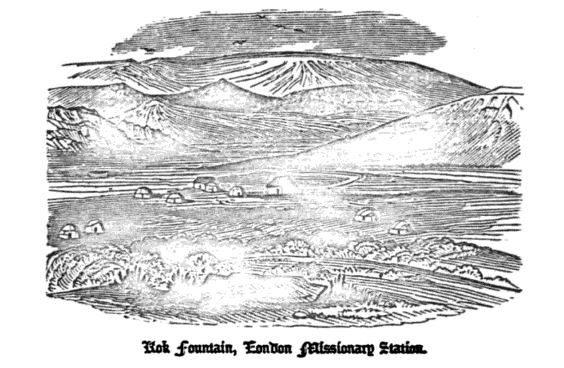
Kok Fontein was in the land occupied by Basters under the leadership of Kobus Engelbrecht and the Witbooi Orlams and their leader Kaptein Kupido Witbooi. The Witbooi Oorlams are a sub-tribe of the Nama peoples. They were originally mixed race descendants of the the Khoikhoi peoples who migrated from the Cape Colony up to Namaqualand.
In 1822, Susannah gave birth to a daughter, Susannah Maria. However, Michael’s wife, Susannah died sometime around 1822 or 1823. Perhaps she died in childbirth.
In any event, Michael was left with two young children to raise. In 1824, Michael announced to his LMS superiors in London that he was intending to marry a Margarethe Beukes who was the daughter of a local Baster, David Gert Beukes, from nearby Silverfontein. They were married in 1824 in Cape Town.
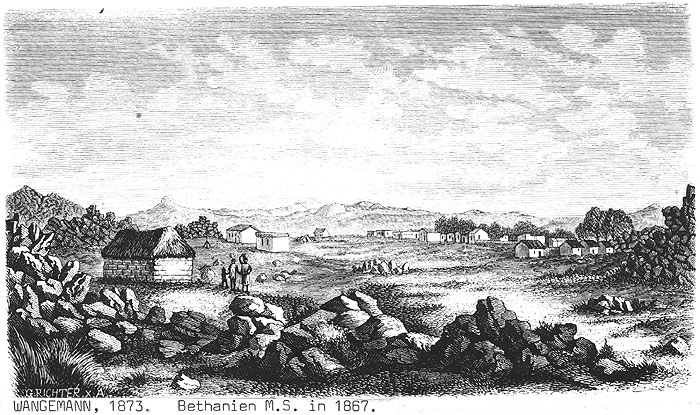
The Bethany Missionary Station run by Michael’s fellow missionary and friend, J H Schmelen
From reports, Michael settled well at Steinkopf although conditions were harsh as it was often necessary to move around to find the best land and famine often occurred. He appears to have been highly regarded by the local Witbooi people . James Backhouse, who travelled through South Africa in the 1830’s and 1840’s, said the following about Michael Wimmer: “There seemed to be the effusion of a heart overflowing with love for his little flock, and with earnestness in putting them in remembrance of the importance of not only laying hold on eternal life, but of keeping hold of it. Observing that he spoke in Dutch, and recollecting a remark of Margaret Wimmer, that few of the people understood anything but Hottentot, I queried with the good old man afterward, if all who were present understood Dutch; he smiled and said, “No, but I forgot the interpreter.”” It would appear he had a bit of a sense of humour too.
The rest of Michael’s life was spent supporting the local people. It was a difficult life, he would often travel with local indigenous people who followed pastoral lifestyle, following their herd of livestock over the landscape. He preached to them and his daughters ran a small school. He baptised the few that converted and stood by those that did not. He writes about how the drought and hunger of “his people” made believing in god challenging.
The life was not without personal danger: he recounts about the murder of a fellow missionary Mr Threlfall in 1825. At times life must have got him down: he once signed one of his reports to the Directors of the LMS with the words “Micheal Wimmer..some say that it would be better that he would go away and another would come in his place…”.
Michael and Margarethe had six children: Elizabeth (b. 1829), Michael (b. 1831), David Gert (b. 1834), Johannes (b. 1835), Martha (b. 1836) and Susanna Rosina (b. 1836).
I think Margarethe died around 1837. Michael died on the 21st June 1840 at the age of 79. James Backhouse writes, in his book:
“This veteran missionary finished his course, in the 77th (sic) year of his age, on the 21st of 6th mo. 1840: he had migrated with the people to a place called Fries Klip, and had been expostulating earnestly with them on their indifference in the pursuit of heavenly treasure. After they withdrew, he conversed on the same subject with a man who remained. While thus engaged, he bowed his head as if in deep thought, but it was soon discovered that his head was bowed, to be raised no more; his spirit had fled to its everlasting habitation. His remains were interred at Kok Fontein on the 24th, when his neighbour and fellow-labourer, J. H. Schmelen, bore a lively testimony to his worth, among the assembled people.”
His daughter later wrote:
“I am certain he died in mellow contentedness, unshaken in his dedication”
 Things you didn't know about my family
Oh wow! I literally just teared up… feeling so very proud of him… What a man!
LikeLiked by 1 person
Grivelin. My apologies for not picking up on your messages before. I’m not sure what happened. I would live to share more with you. If you would like to me privately – deb.slater@bigpond.com – thank you Debbie
LikeLike
I forgot to mention Michael Wimmer Sr, is also my great great great grandfather.
LikeLiked by 1 person
I have been researching somewhat on the work of Michael Wimmer (sr) and would like to contact you. I am in contact with a number of the descendants of the Rev Johann Friedrich (Frederik ) Hein. You may contact me at email: manager@tulbagh.today, Calvin S van Wijk
LikeLiked by 1 person
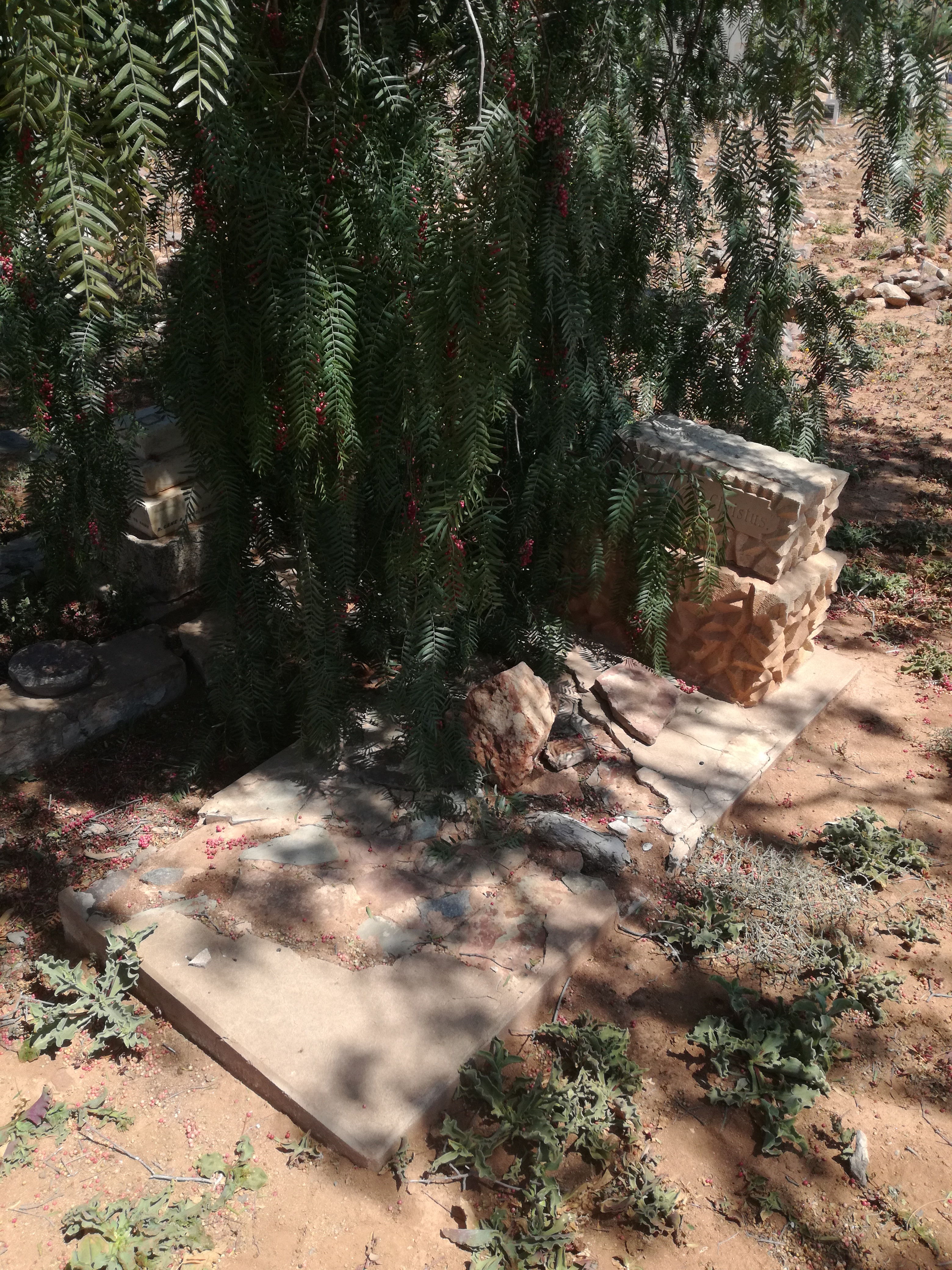
Dear Debbie, I should just mention to you that a Wimmer descendant, Mr Boeboe van Wyk of Steinkopf, in Namaqualand told me that he intends getting other Wimmer descendants to restore Michael Wimmer’s grave in the mission church cemetery in Steinkopf in the next year. Should you be interested to contact him, his email address is: boeboevanwyk@gmail.com. It is my last two weeks working at the museum at Tulbagh. I will then have another email addres, will then contact you. Kind regards.
LikeLike
What an interesting story! I happened to come across your article whilst searching for the Caledon institute. I wanted to google infomation about the Caledon Institute as both my ancestors had that noted on their marriage record in 1840. They were David Roman circa 1816 and Susanna a.k.a Sanna Fourie circa 1819. For a very brief moment, I thought your Susanna was mine but then kept reading to the end!
LikeLike
Thank you for your comment. There is quite a bit online about the Caledon Institute. If you are in the UK, University of London, SOAS, has a great archive of material. Hope you find out lots about Sanna and David
LikeLike
Hi Debbie your blogs about the Wimmer family were very interesting to read. Can you give me the url or website for this Caledon Institute you referring to?
LikeLike