In addition to their military-inclined sons, Mary Ann and Gervase Tinley had two daughters: Henrietta and Letitia, born when Mary Ann was in her 40’s. Both Henrietta and Letitia were born in Ireland, where their army officer father had been stationed. Letitia is Mike’s gt. gt. grandmother.
The two sisters were twelve and fifteen years of age when their father died in 1838 and lived with their widowed mother in England. A son, Francis, who was 17 when his father died was also living at home when his father died. At the time, they were living in Plymouth just off the Hoe. As an ex-soldier, Mary Anne was entitled to a pension and the three last children were supported by an allowance from the Royal Hospital Chelsea as children of an ex-officer until they reached adulthood.
Francis went on to join the army too: joining the Royal Welsh Fusiliers.
At the age of 16, Henrietta married a Colonel Louis T. F. L. Belin in London, but within seven years she was a widow and the mother of a three year old son, Leon. As a widow she went back to living with her mother and younger sister, who had moved to Worthing in Sussex.
At around the age of 21, on the 31st December 1856, Letitia married a Frenchman by the name of Octave Henri Seiller in Dinan, France. How she came to meet him, I have no idea.
Letitia lived with Octave for 12 years – living in Northern France, Paris, and Brussels. They had three children. The eldest child was a son called Georges-Octave Gervaise Newport Tinley, born in Dives-sur-Mer in the Calvados region of France in 1858. Helene Marian was born in Paris, close to Versailles in 1860 . The youngest child was a son called Frederick, born in 1867, in the Cape Colony (according to Census Records). We have to assume, therefore, that at some time in the previous year, Letitia had travelled to the Cape: perhaps to stay with her brother Robert Newport Tinley who was stationed there with the Cape Mounted Riflemen.
By the middle of 1868 she was back in Paris.
By Letitia’s account, Octave was a ne’er do well. He had no regular occupation and often went AWOL. He occasionally bought and sold horses and ran up debts. In 1858 around the time that his eldest child was born, his effects were being sold off: presumably because of debt. In 1863 he was found guilty of poaching.
In 1868, they were living on the Avenue de Neuilly in Paris with their three children.
On the 18th July 1868, Octave left the house with Georges-Octave, never to return. She didn’t hear from her husband for over a year, but in August 1869 she received a letter from him and travelled to Brussels to meet him, although she did not see her son. The reunion was short lived: the next day he took some money from her and left. I have no idea whether she was ever reunited with her first born.
From then on, she was on her own with her other two children. By 1871 she was living in Newport on the Isle of Wight, eking out a life as a needlewoman and receiving financial support from her brother William, a bachelor soldier stationed in Ireland. In February 1874, William died intestate leaving her with a third of his estate but she no longer had any ongoing support from him.
Worried that her husband’s creditors would try and gain access to what money she had, she applied to the courts to have the money protected from his creditors. By mid 1784 she was living in Hertford. Whether or not the protection order was granted I don’t know.
We do know that her money troubles didn’t go away. Within the year she crops up living in London. In May of 1875 Letitia and Frederick are admitted to the Stepney Union Workhouse. They stay there for a few weeks. Her address is given as Church Street which is probably near where the Olympic Park is today. She is listed as being the widow of Octave Seiller. Did she know that her husband was dead, or was it better to say she was a widow rather than an abandoned wife? Had she made contact with him? Where was Helene?
Just a few weeks later, on the evening of June 20th, she is admitted to the Greenwich workhouse having been brought in by a park constable. I would assume that this would be the nearby Greenwich Park. This time she had Helene and Frederick with her. Surprisingly, she gives her name as Ellen (not Letitia) and she states that she is the widow of Octave Seiller, a French lawyer!! What was she doing in Greenwich Park? Where was she actually living at the time?
There’s no record of how long she stayed in Greenwich, but on the 10th August that same year she was admitted to the Stepney Union Workhouse again. On this occasion she is on her own – no children. She is listed as being destitute and her address is 4 Angel Alley. Typing Angel Alley into Google shows that this was in Whitechapel. Further digging unearthed a reference to a book called Ragged London, written in 1861 which describes Angel Alley:
“The best paid occupation appears to be prostitution, and it is a melancholy fact that a nest of bad houses in Angel Alley, supported chiefly by the farmers’ men who bring the hay and straw to Whitechapel market twice a week, are the cleanest-looking dwellings in the district.”

Angel Alley
What was Letitia doing there? Were her children with her?
Angel Alley and it’s neighbouring streets were – a decade later – to gain notoriety as the haunt of Jack The Ripper.
Letitia was clearly on her uppers as we would say. She appears to be very much alone: apart from Helene and Frederick. Her parents were dead and her sister was – by this time – probably living in the Cape Colony. In 1875 her surviving brother – a decorated soldier – was still alive and living in Jersey in what would appear to be relative affluence. When he died two years later he left an estate valued at just short of £400,000 in today’s money. What a contrast.
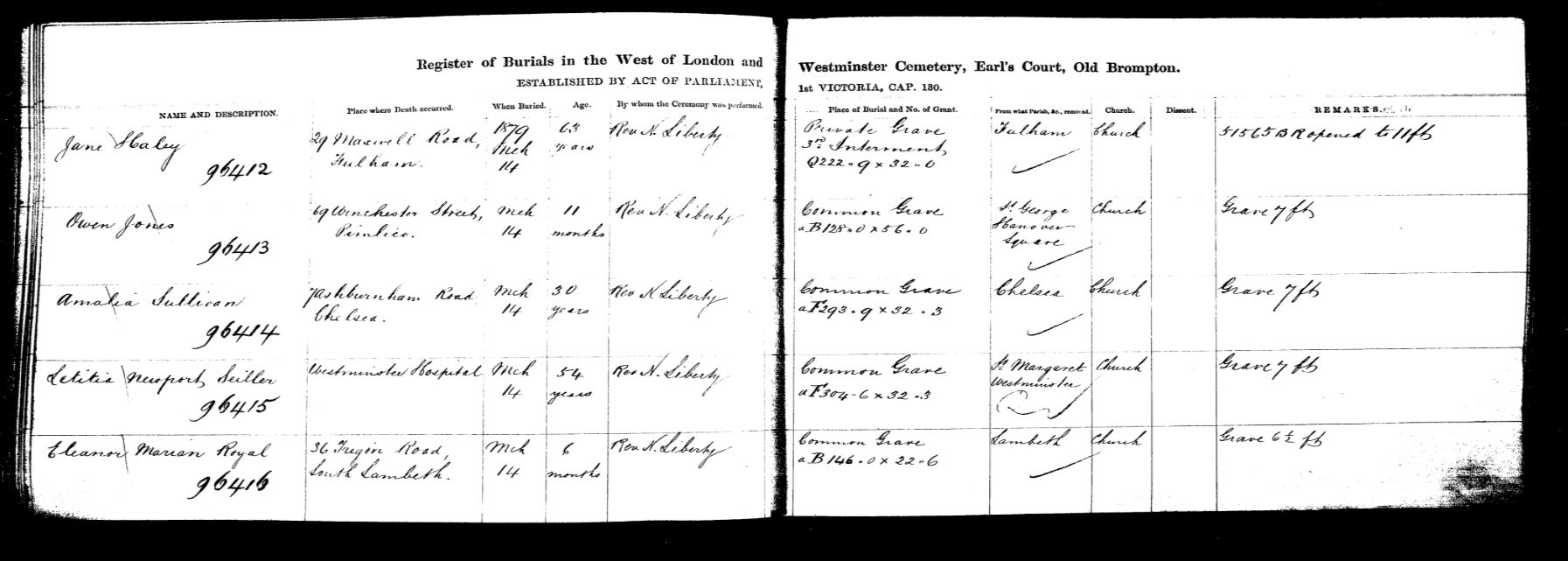
Letitia died of bronchitis just four years later on the 8th March 1879 at the Westminster Hospital – at that time a hospital for the poor. Her age is given as 54 although she was, in fact 45 (perhaps this is just a transposition of the numbers. The informant was the matron: it seems there was no-one there who really knew her.
She is buried in Brompton Cemetery in a common grave.
So what happened to Frederick and Helene? At the time of their mother’s death Frederick would have been only 12 and Helene 19. We know that Helene ended up in the Cape Colony, so perhaps Helene and Frederick went there sometime after 1875: either before after Letitia’s death. In any event, Frederick spent his adult life in Surrey, working in a bank, married: the ultimate in suburban life. He had four children, although two died in infancy. His remaining two daughters (Irene Florence and Edith Helene) lived their life in Hove near Brighton. Neither of them married and died in 2005 and 1989 respectively.
They were Mike’s great aunts. We never knew of their existence.
What about Octave and their son, George-Octave? When I first wrote this piece I said: “I’ve no idea about either – they completely disappears from the records I’ve searched. Perhaps he changed his name to avoid his creditors. As more records come online, maybe I will find out.”
Well, pleasingly, since I wrote this originally, I have found out some more, but this is a subject of another blog.
But what about Henrietta? What happened to her?
Henrietta’s brother, Robert, was stationed in the Cape Colony at Grahamstown in the Cape Colony as commander of the Cape Mounted Rifles and it some point Henrietta must have left England to travel to Africa. Henrietta and Letitia’s mother died in 1860, so perhaps she left shortly after that. There is certainly no mention of Henrietta Belin/Tinley in the 1861 UK census so we must assume that she was out of the country by then. Letitia was living in Paris, so perhaps she felt that a move to Africa was the best option.
Records show that Henrietta married a William Wallace Simkins – a decorated soldier of the Cape Mounted Rifles – at some point after 1854 when William Simkins first wife died. I assume she met William through her brother.
Henrietta formed a blended family with her son Leon Belin, and William’s children from his first marriage. William ultimately retired from the army and joined the civil service. Sadly Leon died in 1876 at the age of 28. William died in Grahamstown in 1900 and Henrietta in 1907.
It is interesting to note that when Letitia’s daughter, Helene, later married and had children of her own, she named one of them William Wallace Tinley Wimmer: a little boy who died at the young age of eighteen months.
 Things you didn't know about my family
Great characters!
LikeLike
[…] You can read the sisters’ story here – https://slaterfamily.blog/2017/07/08/a-tale-of-two-sisters/ […]
LikeLike